News and press releases
IU0VYT Flash 4.45: Free Open-Source Programming Utility Now Covers 623 Radio Models
Nov 22 2026 - daily.hamweekly.comIU0VYT Flash, a free GPL-3.0 Windows program by Italian ham Daniele Bonifazi, IU0VYT, has reached version 4.45. It reads and writes channels and zone names for 623 handheld and mobile models from 54 brands, handles the settings of 556 of them and can update the firmware of 58. New in 4.45 are channels and zones for the Anytone AT-D868UV / Anytone AT-D878UV family and the BTECH DMR-6X2 over the radio's USB cable, plus several TYT and Retevis models with original firmware. The program detects the connected radio, backs up before every write, copies channels between brands and opens CHIRP .img and CSV files. The newest radios have not yet been tried on real hardware, so the author asks owners to start with a read-only test and report results.
Icom Announces European Pricing for the IC-7110 HF/VHF/UHF All-Mode Transceiver
Nov 20 2026 - www.icomeurope.comIcom Europe has announced pricing for the forthcoming ICOM IC-7110, the evolution of the ICOM IC-7100. The recommended retail price is €1,528.00 excluding VAT; availability is still to be announced and E-marking approval is pending. The IC-7110 covers HF through UHF in all modes with 100 W on HF and 50 MHz and 50 W on 70, 144 and 430/440 MHz, and uses RF direct sampling below 74.8 MHz. It offers a real-time spectrum scope and waterfall, dual receive across the HF/50/70 MHz and 144 or 430/440 MHz bands, a built-in CW decoder, simplified FT8 setup, enhanced D-STAR with a DV repeater monitor, built-in GPS, Wi-Fi/Bluetooth, RS-BA1 remote operation over Wi-Fi and online firmware updates.
Doreen Bogdan-Martin, KD2JTX, Re-elected ITU Secretary-General
Nov 18 2026 - www.arrl.orgRadio amateur Doreen Bogdan-Martin, KD2JTX, has been re-elected to a second four-year term as Secretary-General of the International Telecommunication Union, the UN agency that coordinates the radio spectrum internationally. She received 164 of 173 votes cast at the ITU's 2026 Plenipotentiary Conference (PP-26), held November 9–27 in Doha, Qatar. Licensed since 2015 and an ARRL member, she is the third radio amateur to hold the ITU's top post, after Dr. Hamadoun Touré, HB9EHT, and Gerald C. Gross, W3GG (SK). ARRL President Rick Roderick, K5UR, and IARU President Timothy Ellam, VE6SH, both welcomed the result, with Ellam noting that IARU will work with the ITU on several initiatives next year.
Quartzfest 2027: January 17–23 in the Desert near Quartzsite, Arizona
Nov 16 2026 - quartzfest.orgQuartzfest 2027, the week-long ham radio and RV camping gathering in the desert near Quartzsite, Arizona, runs from January 17 to 23, 2027. Attendees park their RVs on BLM land in the Roadrunner Short Stay area; no RV reservation is needed, and the organizers describe it as a very small fee event. Talk-in is on 146.550 MHz. A tentative schedule of presentations and activities was posted on October 25, and the organizers are still looking for seminar presenters, with PowerPoint slots limited. The website also carries the 2027 flyer, a weather forecast for Quartzsite, a vendor list and newsletters for the event.
AMSAT Asks FCC to Protect Amateur-Satellite Segments in 2.4 and 5.8 GHz Direct-to-Device Proposal
Nov 15 2026 - www.amsat.orgOn November 9, AMSAT filed comments on the FCC's proposal (ET Docket No. 26-169) to let unlicensed Part 15 devices such as Wi-Fi and Bluetooth equipment transmit to satellites at 2400–2483.5 MHz and 5725–5850 MHz. AMSAT says it does not oppose direct-to-device innovation, but asks the Commission to keep the new uplinks out of the 2400–2450 MHz amateur-satellite segment, to add no satellite downlink allocation at 2.4 GHz, and to exclude or protect the 5830–5850 MHz amateur-satellite downlink segment. It also asks for no increase in Part 15 power or emission limits and for realistic aggregate interference studies. Its technical appendix finds that roughly 10 to 30 skyward devices at full power could raise a LEO amateur satellite receiver's noise floor by about 3 dB in 1 MHz.
MultiPSK Decoding Software Will Be Free of Charge From January 2027
Nov 13 2026 - www.rtl-sdr.comPatrick Lindecker, F6CTE, author of the long-running MultiPSK decoder, has updated its licence page: from 1 January 2027 no more user keys will be sold and the software will be free of charge. Today a key that unlocks the full version costs EUR 35, and the free version limits most professional modes to five minutes of decoding at a time. MultiPSK is a Windows program that decodes a wide range of amateur and utility signals, including PSK31, RTTY, FT8, ACARS, AIS, POCSAG, DMR, ADS-B and radiosondes. It can connect directly to an RTL-SDR or take audio from any receiver. No reason for the licence change was given.
Hamfest India 2026: November 28–29 at NITK Surathkal, Mangaluru
Nov 09 2026 - hfi2026.nitk.ac.inHamfest India 2026, the country's main annual gathering of radio amateurs, takes place on November 28 and 29, 2026 at the National Institute of Technology Karnataka (NITK) in Surathkal, Mangaluru. This year's event is organized jointly by NITK (VU2REC), the Mangalore Amateur Radio Club (VU2RDO) and the MIT HAM Club (VU2MHC). The organizers describe it as a platform for technical talks, hands-on workshops and networking for experienced operators and newcomers alike, and the event has a call for papers and an accommodation booking service. Details and registration are on the official website.
LinHT Rev C: M17 Project's Open-Source Linux Handheld Transmits M17, Kit Batch Planned
Nov 08 2026 - m17project.orgThe M17 Project reports that the first LinHT Rev C board is alive. LinHT is an open-source, Linux-based handheld that reuses the chassis, display and (for now) SMA connector of a donor Retevis C62. Rev C fixes the problems found in Rev B testing: M17 transmit, USB-C networking, audio, microphone, GNSS (now via a U.FL connector for an external antenna), USB boot from the side button and power management are verified, while power measurements are still to come. Seven Rev C boards exist. Next is a production batch of at least 50 kits, with a ballpark price of EUR 250–400 per kit (tax included, shipping and the donor radio not included), pending a SoM quote from CompuLab. The M17 Foundation will decide how the kits are sold.
ARISS SSTV Series 35 "Space Memories" Runs November 9–16
Nov 05 2026 - www.ariss.orgARISS will run another slow-scan television event from the International Space Station. Series 35, themed "Space Memories", celebrates the history of the Space Shuttle. It begins Monday, November 9, 2026 at 17:45 UTC and ends Monday, November 16 at 08:15 UTC. Images are sent on 437.550 MHz (plus or minus Doppler shift) in Robot 36 mode, with 36-second transmissions followed by two minutes off. Listeners can upload their own decoded images to the ARISS SSTV Gallery to qualify for an event certificate.
HamCation 2027: February 12–14 in Orlando, Florida
Nov 02 2026 - www.hamcation.comHamCation 2027 takes place February 12–14, 2027 at the Central Florida Fairgrounds and Expo Park in Orlando, Florida. The event bills itself as one of the world's largest hamfests and hosts the ARRL Southeastern Division Convention. The programme includes commercial vendors, swap and tailgate areas, forums and speakers, amateur radio license exams, a special event station, prizes and an awards banquet with a keynote. Visitors can navigate the show with the ARRL Events app. Tickets, vendor registration and hotel and parking information are available on the HamCation website.
DXLook Adds an Antenna Comparison View Based on WSPR and PSK Reporter Data
Nov 02 2026 - daily.hamweekly.comDXLook has added an Antenna view (under Maps, then Antenna) that shows how well your antenna performs compared with nearby stations, without test gear or a second station. It takes your callsign, finds stations within 300 km, and compares how the same receivers heard you and them at about the same time, using reports from WSPRnet and PSK Reporter. Because the receiver, noise and propagation path are shared, the comparison is more meaningful, and DXLook uses the median over many stations so one outlier doesn't skew the result. For WSPR, reported power is normalized out. For FT8 and FT4, where power isn't reported, each neighbour's typical difference from your station is removed as a baseline.
eBay Restricts Radio Equipment Listings, but Exempts Ham-Band-Only Gear
Oct 16 2026 - www.arrl.orgNew FCC rules that took effect on October 13 make online marketplaces share responsibility for keeping unauthorized RF devices off their platforms. Equipment subject to FCC authorization must now have its FCC ID posted with the listing, with exemptions for existing posts, small sellers and used equipment. After early messages to sellers suggested an FCC ID would be needed for any transmitting gear, ARRL asked eBay for clarification. eBay confirmed that devices operating only on amateur radio frequencies need no FCC ID, since they do not require equipment authorization. VHF/UHF two-way radios that can operate outside the amateur bands still need FCC certification to be sold in the US. The underlying authorization rules did not change: amateur equipment, except commercial HF amplifiers, still needs no FCC authorization.
JTTY: New RTTY-Style Digital Mode in WSJT-X 3.2
Oct 06 2026 - www.cqdx.ruWSJT-X 3.2 introduces JTTY, a new digital mode designed for fast RTTY-style contest exchanges and keyboard-to-keyboard communication. Unlike FT8 and FT4, JTTY has no fixed transmit and receive time slots, so a transmission can start at any time. It uses 4-GFSK in an occupied bandwidth of around 125 Hz, giving roughly 30 words per minute for arbitrary text and up to 60 WPM for optimized contest exchanges. N1MM Logger+ already supports the mode. Because JTTY can carry free text with forward error correction, it may also suit emergency and field communications. The mode is still very new, so operating practices and preferred frequencies are expected to evolve.
Icom Unveils the IC-7110 HF/VHF/UHF All-Mode Transceiver
Aug 29 2026 - www.icomeurope.comIcom introduced the new ICOM IC-7110 at the JARL Ham Fair 2026 in Tokyo (August 29–30). The all-mode transceiver covers HF, 50, 144 and 430/440 MHz, with 70 MHz available on the European version. Highlights include a real-time spectrum scope and waterfall, a 4.3-inch colour touch display, a CW decoder, comprehensive D-STAR functionality and Dualwatch for HF/VHF and HF/UHF. FT8 operation gets a simplified configuration, and Wi-Fi (2.4 and 5 GHz) and Bluetooth connectivity are built in. Icom Europe has published pre-release information and a promotion video; final specifications are still to follow.
4O3A Station Manager: One Console for Radios, Amplifiers, Rotators and Antenna Switches
Jul 07 2026 - www.cqdx.ruThe 4O3A Station Manager is a programmable hardware console for central control of a whole station, locally or remotely over LAN or the Internet. It has 24 programmable buttons and 12 programmable rotary encoders, plus profiles for setups such as FT8, RTTY and SO2R. Version 1.0 supports 4O3A's Power Genius, Tuner Genius, Rotor Genius and Antenna Genius products, and transceivers including the Kenwood TS-890S, Yaesu FTdx 101D, ICOM IC-7610, ICOM IC-7300, Elecraft K3 and Elecraft K4. Networked radios connect directly by LAN; RS232 and CI-V radios use the optional CAT2LAN adapter. It connects by LAN, Wi-Fi or GSM, and ACOM and OM Power amplifiers and more rotor controllers are planned.
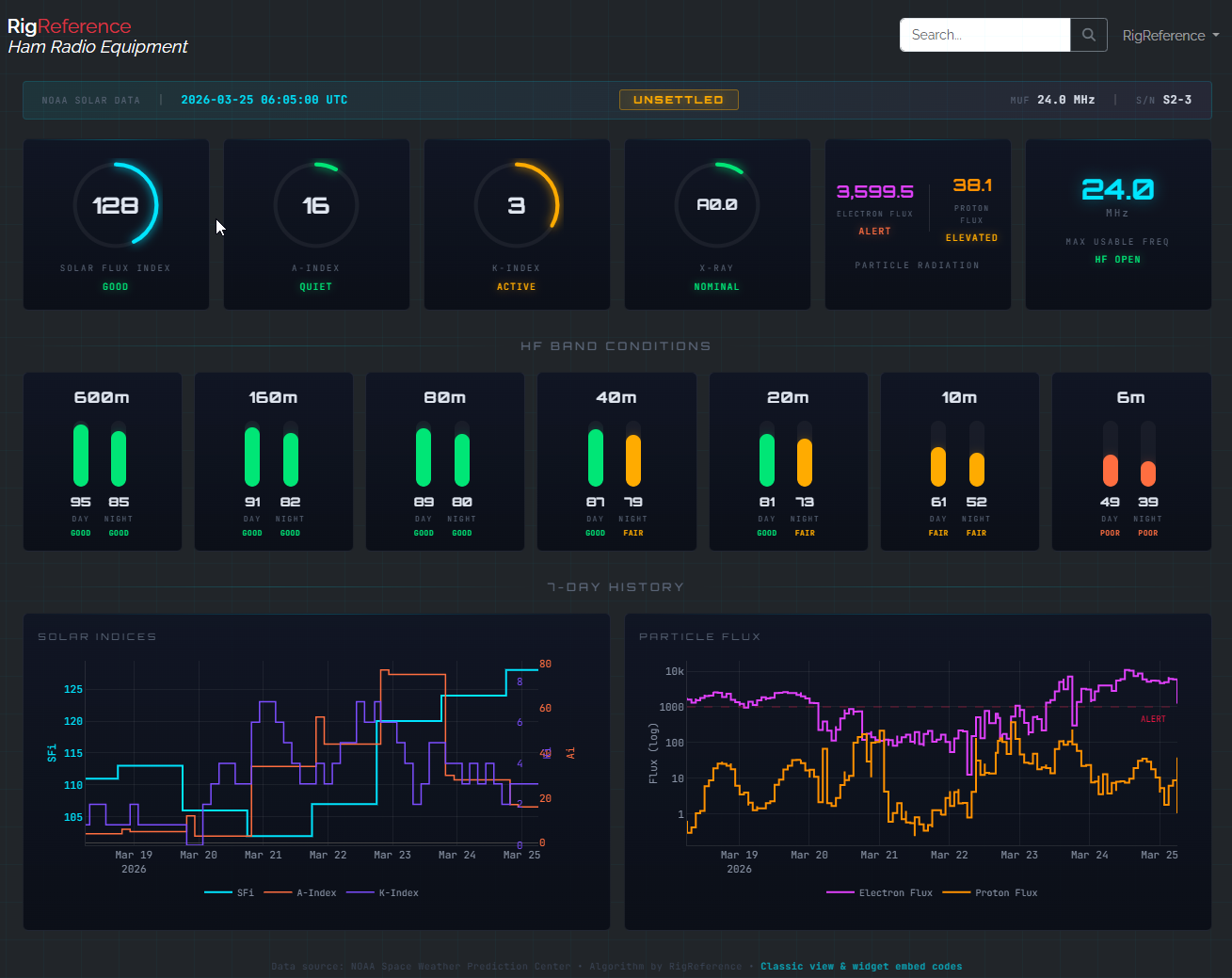
Solar Conditions Dashboard
Mar 25 2026 - rigreference.com
Check out our new Solar Conditions Dashboard. It shows all available metrics in one clear overview - conditions per band, solar storms, particle flux, A-, K- and Solar Flux indexes and more.
https://rigreference.com/solar/dashboard
Additional Information on the IC-7300MK2
Dec 19 2025 - www.icomeurope.comThe IC-7300MK2, a next-generation HF transceiver by Icom, is scheduled for release in December 2025 in Europe. The target price is approximately EUR 1,299 excluding VAT. This version includes the 70 MHz band and builds on the success of its predecessor, the IC-7300. Information may be subject to change.
Icom Unveils New IC-7300MK2 HF / 50 / (70) MHz Transceiver
Dec 19 2025 - www.icomeurope.comIcom introduced the IC-7300MK2 HF/50/(70*) MHz transceiver at JARL Ham Fair 2025, with shipments planned by year-end. The model builds on the success of its predecessor, which sold over 100,000 units globally. Enhancements include improved RMDR and phase noise performance, reduced RX standby current consumption by about 23%, and a new HDMI port for external displays. It features a built-in CW decoder, separate receive antenna connector, USB Type-C with dual virtual COM ports, and built-in LAN for remote operation without a server PC. The Europe version supports the newly allocated 5 MHz band and includes 70 MHz capability.
mAT-1500ProII is a versatile automatic antenna tuner
Dec 19 2025 - www.cqdx.ruThe mAT-1500ProII is an automatic antenna tuner for transmitters and linear amplifiers, supporting up to 1500 watts (SSB) or 800 watts in digital mode. It operates from 1.8 to 30 MHz, matching various coax-fed antennas with complex impedances. The device features two antenna connections, three operating modes (GENERAL, YAESU, ICOM), and supports remote control via RS232. Optional cables allow direct transceiver control without extra power sources. Notable for its speed, precision, and ease of use, it offers 16,000 memory locations with tuning times up to 8 seconds or 0.1 seconds at stored frequencies. The LCD displays real-time RF power, SWR, and status. It includes a PTT loop-through with automatic interruption during tuning and manual fine adjustment options. Connectors include "RF-IN," "ANT1/ANT2" (SO-239), grounding, control jacks for YAESU/ICOM/KENWOOD, DC jack (12-14 V, 2 A), RS232, and RCA cables for PTT control. The tuner is housed in a robust aluminum casing weighing 3.5 kg, suitable for temperatures from -10°C to +60°C.
LP-100A Digital-Wattmeter
Dec 19 2025 - www.cqdx.ruThe LP-100A Digital-Wattmeter, designed for frequencies between 1-54 MHz, is recognized as an industry standard reference power meter. It features dual bargraphs, a graphic display with solid bargraphs, and a unique SWR alarm with snooze mode. The device includes 11 bands of frequency indexed NIST traceable calibration points via a built-in frequency counter. Additional modes include vector impedance, dBm/RL, calibrated field strength, and compression ratio. It comes with an LPC1 coupler, connecting cables, power cable, and software (VCP, Plot, MCLoader). The LP-100A is priced from $525 USD for the basic model to $910 USD for models with additional high-power couplers.
About
RigReference.com aims to become the most comprehensive reference guide for ham radio equipment. If you have any questions or suggestions, or if you'd like to participate, please get in touch.
 Buy me a coffee